Saturday, April 25, 2015

Coloring Books for Adults


I was contacted a few days ago by a writer at CNN doing an article about the popularity of coloring books for adults. The article was posted on the CNN website April 21, 2015. Here is the full text of her questions and my answers.


CNN: What are the general benefits, if any, of coloring as therapy?

Art therapists are specially trained to provide psychotherapy combined with the visual arts. Art therapists assist clients in their use of art media, the creative process, and the resulting artwork to meet personal goals and needs. Art therapists abide by a professional code of ethics that requires they carefully consider the needs of their clients when determining art projects. People who do not have training and professional credentials cannot ethically refer to themselves as art therapists or their ventures as art therapy.

Art making is a powerful intervention. Neuroscientific research has shown that through the use of art therapy, the human brain can physically change, grow, and rejuvenate. However, offered by unskilled practitioners, art making can make chronic problems worse, or awaken the painful symptoms of traumatic stress.

Most art therapists encourage their clients to create their own original art work rather than color pre-formed designs. However, coloring designs in coloring books is one of many projects a professional art therapist might use. 
 
   For a person who is afraid to draw
               For a person with brain injury who is unable to draw
               For a person who needs help controlling anxious, angry, sad, or lonely feelings between art therapy sessions
               For a person who would benefit from the pleasure of a creative outlet

CNN: Do you utilize coloring books or materials in your therapeutic practice with adults? With children?

I sometimes give clients one of my mandala coloring books for homework between sessions with me. Since the coloring book is created by me, it is a reminder of our therapy work together. Coloring mandalas can empower a client to manage thoughts and feelings on their own with the positive activity of coloring, instead of, for example, overeating or abusing substances.
The mandala coloring books I have created are intended for adults. Each one has a text introduction with color illustrations explaining what mandalas are, and how best to benefit from using the coloring book. Each of my mandala coloring books has a theme. Coloring Mandalas 1 is about the process of growth and transformation. Coloring Mandalas 2 includes mandalas that inspire balance and wellbeing. Coloring Mandalas 3 is focused on symbols and traditions of the divine feminine. Coloring Mandalas 4 is comprised of mandalas that stimulate energy and taking appropriate action.

CNN: Would the coloring projects you assign differ by the age of the client in intricacy or pattern?

Although my mandala coloring books are for adults, people tell me their children enjoy coloring them. Teachers copy designs from my coloring books and give them to students for focus before and relaxation after test taking. Church leaders use coloring mandalas on church retreats with people of all ages, and find sharing mandalas enhances connection between the different age groups. Those sitting at the bedside of a sick loved one in the hospital report welcome relaxation for themselves and the loved one observing them color.

CNN: Do patterns matter? More specifically, do you use abstract patterns to provoke a certain therapeutic outcome versus using representational images to achieve other outcomes?

I include mostly abstract designs in my mandala coloring books. This gives the person coloring more freedom to project personal meanings onto the design. Designs do matter. I rely on the circular form of mandalas in all the designs in my coloring books. The circle conveys a sense of safety, focus, and energy that most people find comforting.  I consider coloring a mandala to be the safest (least likely to re-traumatize) the person coloring. This is because mandalas are familiar: we all created mandalas when we were small. Children’s art from around ages 3 – 5 always includes mandala designs in the form of suns, people, and animals. A symmetrical mandala design with 4, 6, 8, or more even numbers of elements (such as flower petals, star points, circles, etc.) seems to be most soothing. Mandala designs based on a structure of 2, 3, or 5 tend to stir up energy. Different designs pull for varying qualities of emotional energy, so I do give careful thought to the needs of a client when recommending a coloring book.
 
CNN: How does color or hue factor in?

People have free choice of colors for their coloring book projects. The freedom to choose is empowering, especially for those who may feel powerless because of a personal situation, emotional problems, or physical disability. Color meanings are very personal. There are no assigned meanings for colors supported by research. An individual will have associations with colors based on their life experiences, cultural background, and emotional state at the time of coloring. I encourage my clients to choose colors that feel right to them at the moment, and not worry about what the color means. Later, if they choose to, they can go back and look at their completed project, and gain personal insights about their choices of colors. I give guidelines for interpreting colors in one’s own mandalas in my books Creating Mandalas and The Mandala Workbook.

People also have a choice of medium: colored pencils, crayons, water colors, marker pens, pastels, paper collage, glitter. For beginners, I recommend good quality colored pencils. They are easy to use, give bright, colorful results, and can be blended. For those with a weak grip or eyesight problems, markers are a good choice. Water coloring gives beautiful results for those who have skill using the medium. Mixing media is fun. Adding glitter, a tiny cut out of a bird, a dried flower, or even a snippet of a ticket to a memorable event can enliven and personalize a coloring project.

CNN: What are the physical and mental outcomes you look for when employing art therapy such as coloring? For example, are you hoping to achieve: lowering blood pressure, stress relief, or relief of mental illness symptoms?

Outcomes I hope for from a mandala coloring book experience:
               Stress relief
               Better mental focus
               Improved mood
               Reduced anxiety
               Pride in accomplishment
               Sense of personal efficacy
               Courage to try making their own art


Wednesday, February 25, 2015

What is Special about Drawing in a Circle?

What is special about drawing in a circle? Isn’t any kind of art making beneficial for discerning our unconscious?

Drawing, painting, collage, or pottery: all carry very personal messages from hidden parts of ourselves that deserve our conscious respect and attention. Working with our hands using such materials stirs healing energies within us, and allows expression of feelings that we cannot put into words. Journaling; paying attention to our symbol vocabulary as expressed in our dreams; discussing our creations with a trusted person or group are ways to gain awareness of these messages. This is all very good, and good for us. However, it seems that doing this creative work inside a circle has additional benefits.

The shape of a circle is embedded in elements in our body (eyes, breasts, pregnant womb) and this similarity naturally attunes us to respond deeply to the form of the circle. We take in and process information about our surroundings through the circular openings, or pupils, of our eyes.

Orienting ourselves in our natural surroundings, we refer to the horizon line when we can to establish the furthest point we can see. This line is a huge circle around us, clearly marking a portion of the earth to which we can relate with visual knowledge. In some way we consider this our territory, conflating it with our physical being/identity.

In our social milieu, we tend to claim our social space, a circular space a few inches outside our physical body, as our personal safe zone. We prefer that most people come no closer to us than the boundary of this personal zone. Our intimate friends and family we are comfortable allowing them to come closer.

Examining the art of young children around the age of 3 reveals the importance of circle drawings. At this important time, children are developing a personal identity, such that they begin to call themselves “I” instead of the 3rd person naming such as “baby,” or “Billy.” They create mandala drawings of suns, stars, …. And people. I have witnessed a toddler name her drawing of a circle “baby,” her nickname in the family. She was processing the idea that she was an individual, a little person like no other.

This alignment of the circle with personal identity is one that CG Jung experienced in his art and that of his patients. He constructed his theory of the psyche as a central organizing principle anchoring personal development. The psychological experience of this psyche, Jung found, is often expressed in a circular design he called mandalas.

Gestalt psychologists find that the circle is a powerful form that organizes information, and tends to structure what is placed inside.


When we draw in a circle, we are inviting all these layers of meaning, personal identity, and potential for organizing and understanding to reveal themselves in our personal symbolism. The circle, like a microscope, brings context and focus to our self-reflection. For Jung, drawing a circular mandala was the pre-eminent indication that the process of individuation was actively shaping the psyche to become a more complete expression of its potential.

Mandalas in Fiction

I'm reading The Plumed Serpent by D.H. Lawrence. It's about a man who is deeply called to revive the pre-Hispanic religion of Mexico. He channels Quetzalcoatl, the god of the Aztecs. He liberates the local church, and paints it inside in bright colors: green, yellow, red, black, white. Natives are summoned there by drumming. They dance their ancient circle dances. I love the descriptions of the drum circles, the firelight, and the energizing influence these have on the local people. The book is placed near Lake Chapala, Mexico. I just came back from a two week stay in this area, happy to see that bright Mexican colors are everywhere in the village of Ajijic where we stayed. It's an old book, and not exactly politically correct, but I find it quite interesting.

Wednesday, February 26, 2014

The Center in Mandalas

Circles appear in nature, in the sun, moon, stones, caves, flowers, and so on. Human beings have learned to draw circles, perhaps imitating the forms they saw in nature. A circle can be created with a single flourish, a stroke of the brush. This is an important meditative action in Zen Buddhism. The resulting empty circle is called an "enso." The more common way to draw a circle (without a paper plate!) is by establishing a point to become the center of the circle. Using this center as an anchor point, a string, stick, or other instrument is swung 360 degrees around the center to draw a circle. This necessary action in the creation of a circle has become intensely layered with meaning. For example, in a large circle, a person may stand on the center to draw the circle. Thereafter, the center point becomes cognate with the person herself. The surrounding circle can manifest the universe of which the person is a part. Even looking at a smaller circle, the artist can identify with the center as if they were standing there. Therefore, the centered circle can help the artist feel a part of the Cosmos. This establishes a line of thought whereby the center of the circle can also be thought of as the Center, the navel of the world, the Oomphalos where creation manifests, where all that is enters into being. 

Many legends and folktales describe the birth of a people as emerging from such a center (a cave, an underground spring, a mountain). So, the reverence for caves and mountains among ancient peoples can also be considered a focus on “centers”. People began to build structures to emulate such natural sites. The ziggurats of Iraq are stepped mountains. They are also prototypical 3-D mandalas. To mount the steps of the ziggurat is to move closer to the center of the mandala. We see similar designs in the great mandalas of India and Tibet. The message seems to be: the center is a point of perfect alignment with the powers that be, i.e., the Cosmos. Mandalas are apparently built to commemorate such an experience, and also as a guide back to that experience.

CG Jung built on the Eastern traditions in establishing his concept of the psyche (which is illustrated as a mandala). The center in Jung’s schema is the Self. So, one way to interpret mandalas is that the center symbolizes the Self. However, it is more complicated than this, because Jung opined that the whole mandala also exemplifies the Self, as well as all the psychic elements being arranged by the matrix of the Self: ego and other archetypal elements.

I personally believe that the design construction of a mandala can flow between having a visible center and having a non-visible center. Just as a center point is necessary to draw a circle, I believe that a circle establishes a center, even when you cannot see the center. It has to do with the way our brain organizes visual gestalts, or patterns. In creating mandalas you may emphasize the center or not. Depending on your goal for your mandala work, you might establish a visible center or not. I prefer to let people decide for themselves about whether to make a center point or not, so as to have a more natural expression of what they are experiencing at the time.


The center of the mandala is very important.

Friday, September 13, 2013

Emptiness, Migraine, and Me

As part of our exploration of emptiness, the teachers at Drepung Loseling Monastery in Atlanta invite us to think about our self, asking such questions as, What is my self? Where is it located? Is it in my body? Is it in some part of my body, such as my hand? Is it in an organ, such as my liver, heart, or brain? I have found my self is elusive and impossible to locate. It seems devoid of any independent existence I can pin down.

So, you are wondering, what does this have to do with migraines? Well, I have had more migraine headaches than I would like during the last 6 months. I can usually tell when a migraine is coming on. I gain a couple of pounds overnight as my body retains fluid and waste. Sometimes I experience certain visual effects. Anxiety may go up, energy goes down. So in August, when I noticed these things happening, I chose to be very observant of the migraine process, from the view of emptiness of self. The first thing I noticed was that with emptiness of self, the pain was not a direct threat, insult, or injury to me, but merely an interesting phenomenon that depended on other circumstances for its existence. I began to note the chain of events leading up to the headache.

What I learned was that tightness in my shoulders was an important generator of the headaches. The tightness was somewhat related to stress and tension, but most of all it was sore muscles following my workouts at the gym. Second, I noticed that I was feeling thirsty. Very thirsty. So, based on this new awareness I did something different. I stopped my activity, took some Tylenol to ease the post workout muscle tightness, and sat down to relax. I gave my full attention to releasing the muscles in my shoulders, arms, and legs. A warm pack on my shoulders helped. And I drank water until I was no longer thirsty: two glasses, followed by another glass an hour later, and even more the next hour. I did not read, watch TV, or listen to music. I closed my eyes, put on my eye shades, and imagined my shoulders becoming soft and loose.

 I took these actions in a mildly detached way, not out of anxious desire to relieve the headache. This helped me stay calm as I put each different measure in practice. I was freed from the stress of hoping for a desired outcome. As I relaxed, I pondered the new (to me) idea that these things leading to a headache were not some terrible, awful, irritating development, but merely happenings in an interdependent chain of events unfolding according to the law of cause and effect.  I was merely substituting different elements in the chain of dependent arising. And the headache that was arising reversed its trajectory, and quietly faded away.

Ironic how becoming accustomed to thinking of my self as empty of independent existence has helped me develop better self-care. That is an outcome I was not expecting. Also, as I deepen my understanding of the ideas of emptiness and dependent arising, I experience more and more a sense of lightness and freedom that is quite pleasant, sometimes even blissful.

Lesson 10 million and 1, and counting: our mental attitudes have a profound effect on our sense of well-being! 

Wednesday, August 7, 2013

July 2013 Mandala

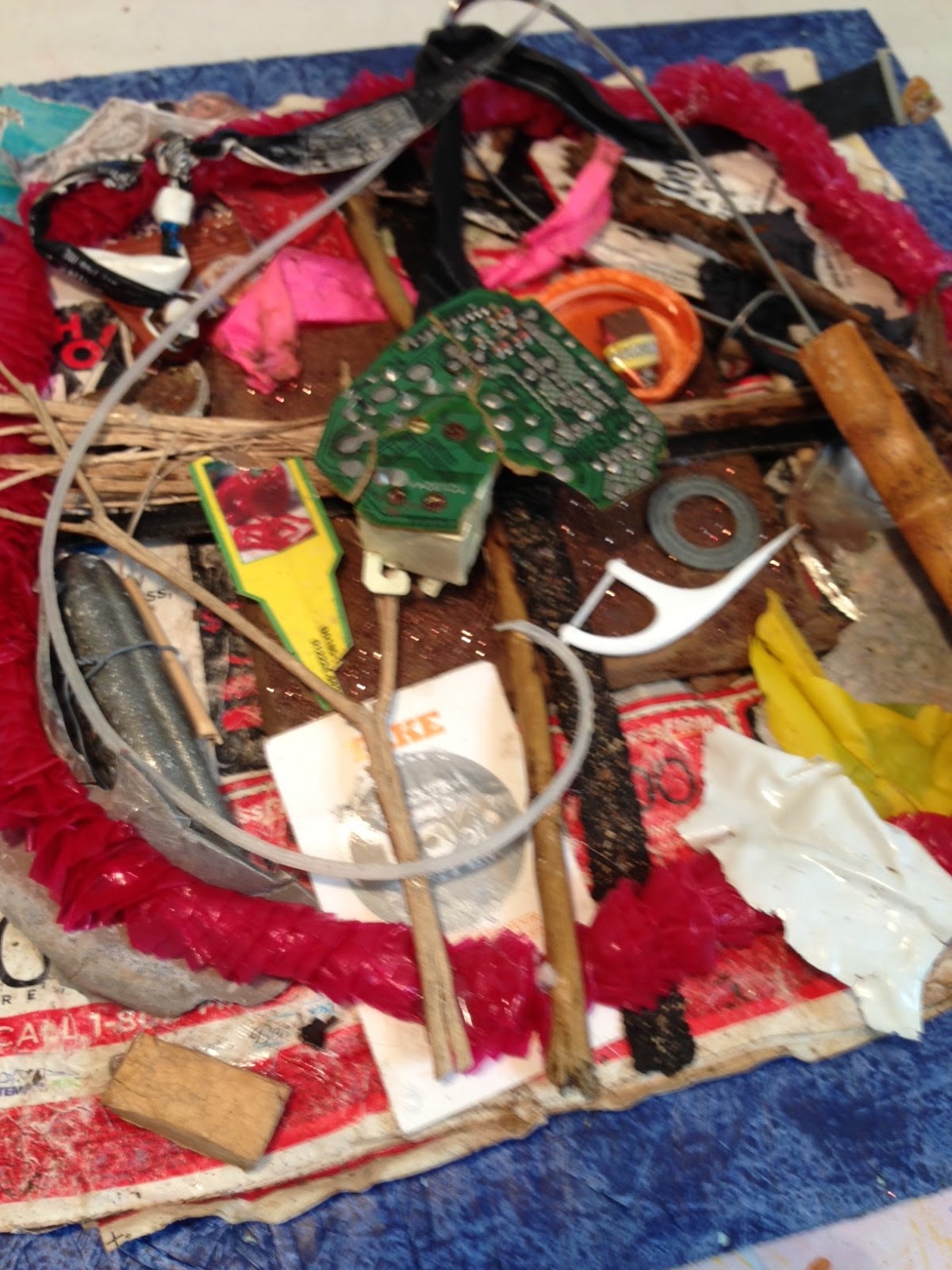
Today I created the mandala for July. I arranged most of the stuff I collected during my walks around the block on a blue board, and began to systematically attach each piece. The bottom layer was a tattered advertisement for July 4th sales, which I coated on both sides with matte medium. On top of that, a brown square of Masonite from down the street. On top of that a strip of black roofing shingle intersecting a slice of black rubber fan belt formed a cross. I cleared out the holes my husband had already drilled in the board, punched holes through the layers of slick paper with an awl, and ran tiny colored telephone wires through to secure a wooden handled object (egg beater? kabob skewer?). Then I warmed up my hot glue gun and attached bits of tar paper, snack packages, a dental floss holder, sticks, a metal washer, cigarette package, and a number of things I don’t know what they are. In the center: a small green slab from a computer with soldered points like gemstones.
Continuing my reflection on “dependent arising” as I worked, I made a discovery! Even though this loosely constructed object made of unrelated fragments challenges the notion of “object”, parts of it still had to be firmly attached in order for the piece to take any form (even temporarily). The necessity for firm attachment, even in this ephemeral object, gave me the “ah ha!” moment. I realized that firm attachment does not negate the view that all things are empty of inherent existence.

The aspiration to ”be free from attachment that holds some close and others distant” has led me to be a bit wary of intimate connections with people, I now realize. Deep emotional attachments are subject to the same realities of dependent arising as everything else, of course. Nonetheless, such attachments are necessary for families and friendships to survive and thrive. Knowing that these attachments are appropriate when life calls for them frees me to care deeply for the ones I love in this lifetime.