
Friday, September 13, 2013

Emptiness, Migraine, and Me
As part of our exploration of emptiness, the teachers at
Drepung Loseling Monastery in Atlanta invite us to think about our self, asking such questions as, What is
my self? Where is it located? Is it
in my body? Is it in some part of my body, such as my hand? Is it in an organ,
such as my liver, heart, or brain? I have found my self is elusive and impossible to locate. It seems devoid of any
independent existence I can pin down.
So, you are wondering, what does this have to do with
migraines? Well, I have had more migraine headaches than I would like during
the last 6 months. I can usually tell when a migraine is coming on. I gain a
couple of pounds overnight as my body retains fluid and waste. Sometimes I
experience certain visual effects. Anxiety may go up, energy goes down. So in
August, when I noticed these things happening, I chose to be very observant of
the migraine process, from the view of emptiness
of self. The first thing I noticed was that with emptiness of self, the pain was not a direct threat, insult, or
injury to me, but merely an
interesting phenomenon that depended on other circumstances for its existence. I
began to note the chain of events leading up to the headache.
What I learned was that tightness in my shoulders was an
important generator of the headaches. The tightness was somewhat related to
stress and tension, but most of all it was sore muscles following my workouts
at the gym. Second, I noticed that I was feeling thirsty. Very thirsty.
So, based on this new awareness I did something different. I stopped my
activity, took some Tylenol to ease the post workout muscle tightness, and sat
down to relax. I gave my full attention to releasing the muscles in my
shoulders, arms, and legs. A warm pack on my shoulders helped. And I drank
water until I was no longer thirsty: two glasses, followed by another glass an
hour later, and even more the next hour. I did not read, watch TV, or listen to
music. I closed my eyes, put on my eye shades, and imagined my shoulders
becoming soft and loose.
Ironic how becoming accustomed to thinking of my self as empty of independent existence has
helped me develop better self-care. That is an outcome I was not expecting.
Also, as I deepen my understanding of the ideas of emptiness and dependent
arising, I experience more and more a sense of lightness and freedom that is quite
pleasant, sometimes even blissful.

Lesson 10 million and 1, and counting: our mental attitudes
have a profound effect on our sense of well-being!
Wednesday, August 7, 2013
July 2013 Mandala
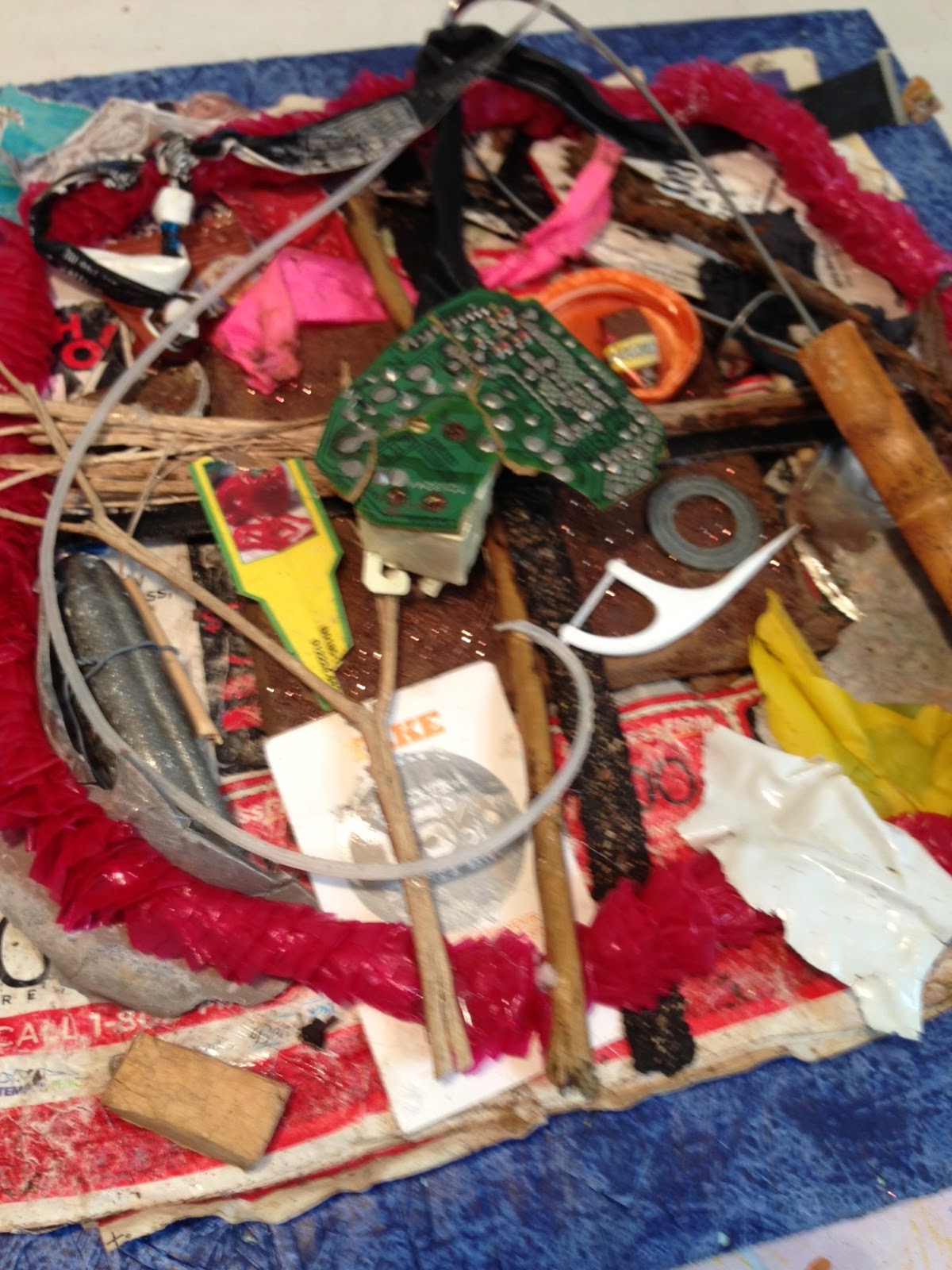
Today I created the mandala for July. I arranged most of the
stuff I collected during my walks around the block on a blue board, and began
to systematically attach each piece. The bottom layer was a tattered advertisement
for July 4th sales, which I coated on both sides with matte medium.
On top of that, a brown square of Masonite from down the street. On top of that
a strip of black roofing shingle intersecting a slice of black rubber fan belt formed
a cross. I cleared out the holes my husband had already drilled in the board, punched
holes through the layers of slick paper with an awl, and ran tiny colored
telephone wires through to secure a wooden handled object (egg beater? kabob
skewer?). Then I warmed up my hot glue gun and attached bits of tar paper, snack
packages, a dental floss holder, sticks, a metal washer, cigarette package, and
a number of things I don’t know what they are. In the center: a small green slab
from a computer with soldered points like gemstones.
Continuing my reflection on “dependent arising” as I worked,
I made a discovery! Even though this loosely constructed object made of
unrelated fragments challenges the notion of “object”, parts of it still had to
be firmly attached in order for the piece
to take any form (even temporarily). The necessity for firm attachment, even in
this ephemeral object, gave me the “ah ha!” moment. I realized that firm
attachment does not negate the view that all things are empty of inherent
existence.
The aspiration to ”be free from attachment that holds some
close and others distant” has led me to be a bit wary of intimate connections
with people, I now realize. Deep emotional attachments are subject to the same realities
of dependent arising as everything else, of course. Nonetheless, such
attachments are necessary for families and friendships to survive and thrive. Knowing
that these attachments are appropriate when life calls for them frees me to
care deeply for the ones I love in this lifetime.

Wednesday, July 31, 2013
Mandala Project 2013

Yesterday I washed all that I had gathered on my walks for
the July mandala. Washing these dirty, broken bits of paper, metal, plastic,
and wood unexpectedly took on sacramental significance. I felt intimately connected
to the individuals who had carelessly let the things drop, thrown them away, or
unknowingly abandoned them. The shambles collected on my studio table made me
aware of my own fragility. But for the mysterious life that animates my body, I
would be like these fragments: just substance dissolving. This was not a morbid
thought at all. In fact, it washed me into knowing how embedded I am in the
cosmic rhythms of all that is. I was filled with a light, fluid, joyful sense
of being: part of an eternal process
ongoing from beginingless time. Closely following this epiphany I remembered
the Buddhist belief of dependent arising
that has become meaningful through this ongoing mandala project: all things
depend for their existence on other things.
Sunday, May 12, 2013
Receiving the Call

Meditations on “Annunciation” seen in the Uffizi Gallery, Florence, Italy
Walking through the Uffizi Gallery last month in Florence, I was stopped in awe by the sight of the “Annunciation” by Leonardo da Vinci. In heavenly shades of pink and blue the painter’s delicate yet carefully structured style illustrates the moment Mary is receiving the message that she is to bear a son—and not just any son--she is to bear the Son of God! The angel kneels before Mary, gently poised as if about to take wing. Mary is shown quiet, calm, and deep in thought. The space between Mary and the angel seems charged with portent, both dividing and joining the two figures.
What struck me about this beautiful painting is Mary’s serene composure in the face of such momentous news. The first time I learned that I was pregnant, I felt elated, pleased, and excited. I also felt a moment of panic. How could I, I wondered, after a few short months, deliver a complete, miniature human being from my own body? I experienced The Call to do something beyond anything I had ever accomplished and I was bewildered, confused, and scared. Well, in due time all came to pass. And I was turned inside out by the experience. After a while I began creating mandalas, and life gradually took on a deeply meaningful new rhythm.
We all receive The Call when we are challenged by life to respond with abilities we may not even know we possess. Hidden in our unconscious, accessible by untried neural pathways, we have not yet claimed these abilities as part of our self-awareness. Carl Jung wrote about this unconscious part of our psyche as a matrix of potentials which we are drawn to discover and live out. Life calls us to this inner work. We respond in our own way. We may lean into trust of the mysterious human wisdom imprinted in our mind/body. Or we may respond out of terror or disgust at the strange call we receive. We may fight the message, or shape it to our own grandiose ends, disowning the mystery from which it emerges. Those who perpetrate violence and terroristic acts may be responding from their fear of an unfamiliar call. Most of us rise to the challenge, discover and use hidden strengths, and in the process become more humble, creative, tolerant, wise, and loving: in short, better human beings.
How will you respond the next time you get The Call?
Sunday, March 24, 2013

West Texas Mandala
“Driving the flat open roads of West Texas one summer day, I noticed that whether my car was stopped or speeding along the highway, I appeared to be at the center of a vast circular space covered with tough, dry grass and mesquite brush. My gaze traveled into the distance, where the horizon was like the edge of a dinner plate, marking the end of the earth in every direction. Feeling the urge for a better look, I pulled over, got out of the car, and made my way through the brush to a sandy patch nearby. I was alone. The sun burned down, unchallenged in its position at the center of a clear blue sky that held nothing back. The intense light forced my eyes into narrow slits. A breeze touched my face.
“I slowly turned, surveying the empty land while the wind whipped my skirt. Occupying the center of the earth as my eyes told me I was, I felt a rush of grateful camaraderie with the sun. I was not alone after all. Suddenly inspired, I picked up a piece of white caliche stone and scraped a circle in the crusty sand on which I stood. Within the circle I felt secure, anchored, protected, like a little one wrapped in a snug blanket. Standing tall at the center of my circle, I felt kinship with the land, the sky, the sun. I had joined with the vast cosmic forces at play in this American grassland. Like many before me at such times, I had constructed a mandala to bring the moment into focus, manage the energy it stirred, and draw the event into my personal domain of experience.” This is from the introduction to my latest book, “Coloring Mandalas 4: For Confidence, Energy, and Purpose.” (Fincher, Susanne F. 2013. Boston: Shambhala Publications, Inc.)
Subscribe to:
Posts (Atom)
